
-
-
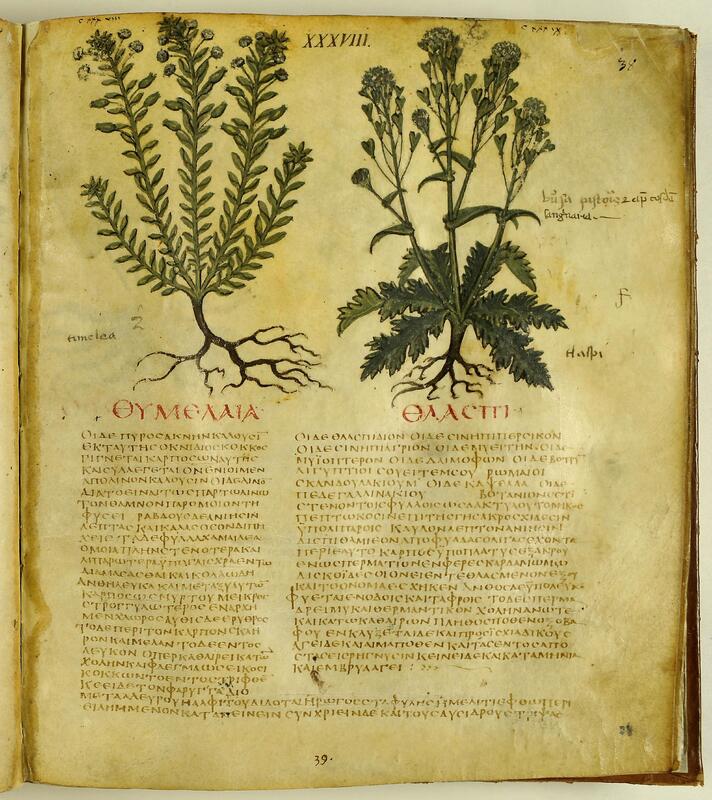
Herbarium: De materia medicaThe precious codex known as the Dioscurides Neapolitanus contains the work of Pedanius Dioscorides, the Greek physician who was born at Anazarbus near Tarsus in Cilicia (present-day Turkey) and lived in the first century AD during the reign of the Emperor Nero. Dioscorides wrote the treatise Perì üles iatrichès, commonly known in Latin as De materia medica (Of medical substances), in five books. It is considered the most important medical manual and pharmacopeia of ancient Greece and Rome and was highly regarded in the Middle Ages in both the Western and Arab worlds. The work covers the therapeutic effectiveness of natural substances originating in the animal, vegetable, and mineral kingdoms. The codex at the National Library of Naples includes only the herbal, which, in its 170 illustrated pages, covers all the known medicinal plants with a commentary that describes each plant, its habitat, and its therapeutic uses. The Dioscurides Neapolitanus is strongly associated with the Dioscurides Costantinopolitanus in Vienna, which was produced in Constantinople in 512 for Princess Anicia Giuliana, the daughter of the Western Roman Emperor Olybrius; both works probably derive from a common archetype. However, the Neapolitan codex does not contain the same anthropomorphic and zoomorphic figures that appear in the Viennese codex and in other Dioscorides codices, such as those held in Paris and at the Palazzo Chigi in Rome. The liveliness of the illustrations, rendered more precious by such detailed commentary, contributes to the antiquarian value of this extremely rare manuscript. The work is also a fundamental source for the study of Greco-Roman medical culture and its reception in the Italian Byzantine world around the end of the sixth and beginning of the seventh centuries. It provides evidence of the intellectual and cultural trends of that era, including a certain preference for a didactic type of text that resembles more a manual than a scientific treatise. As already hypothesized at the end of the 17th century by Bernard de Montfaucon, when he saw the Dioscurides Neapolitanus in Naples and praised it for its beauty, the manuscript is undoubtedly of Italian origin, although exactly where in Italy it was made is unclear. Some scholars trace it to the Exarchate of Ravenna, while others argue it is from the south, in a milieu influenced by the Roman statesman and writer Cassiodorus (circa 487--circa 580).
-
-
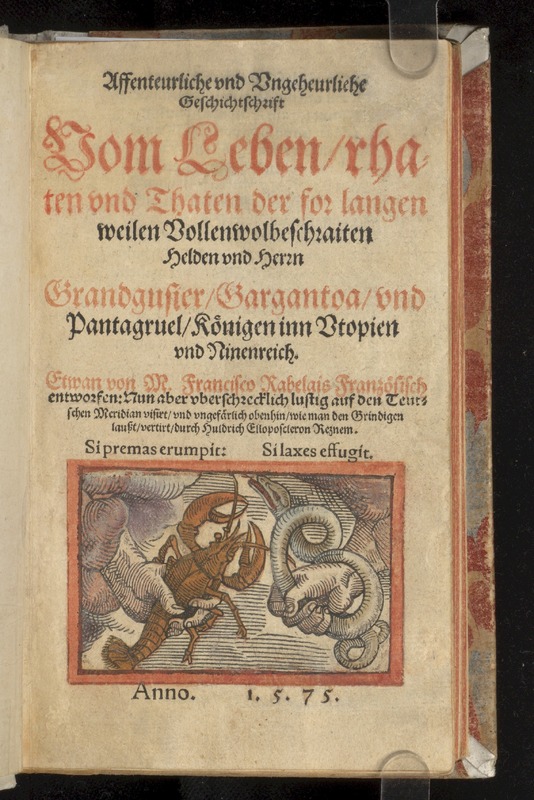 Affenteurliche vnd Vngeheurliche Geschichtschrift Vom Leben, rhaten vnd Thaten der for langen weilen Vollenwolbeschraiten Helden vnd Herrn Grandgusier, Gargantoa, vnd Pantagruel, Königen inn Vtopien vnd NinenreichPrinted book in German, after Rabelais, by Johann Fischart, 1575
 -
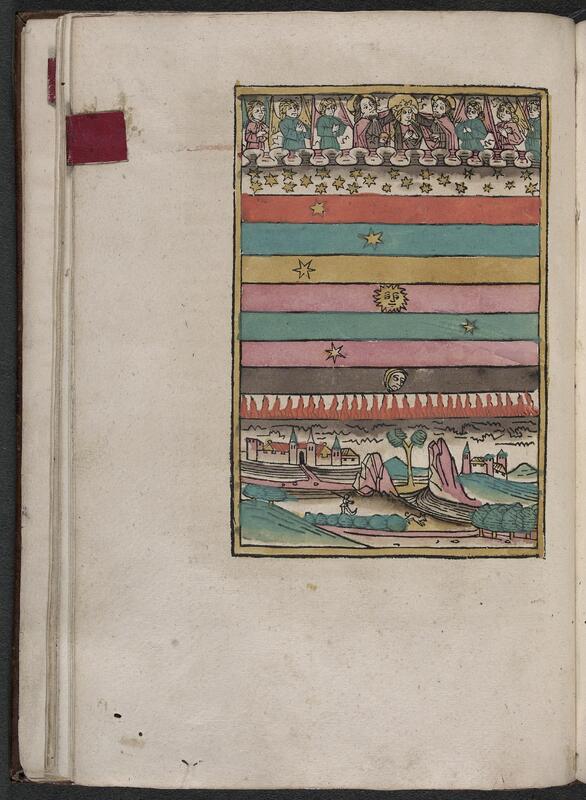 Buch der NaturIllustrated with 12 full-page woodcuts, expertly colored in contemporary hand. The first woodcut shows Christ with a chemist and doctor, rendered in contour lines with a suggestion of architectural background. The second is a stunning depiction of Earth and the seven spheres which separate it from the Heavens. The following eight woodcuts depict various forms of animal, fauna and insects followed by an expertly rendered full-page woodcut portrait of a bishop in full regalia. And lastly, a woodcut depicts several grotesque and morphed human figures, echoing the apocryphal images of Mandeville's travels. Each chapter begins with a large decorative woodcut initial and the rest of the text has a three line initial letters in outline.
 -
Ars vitae contemplativae.Hybrid block book. This copy is illustrated with two leaves of images and text printed in block-book format. The xylographic illustrations contain 12 vignettes depicting lessons from the bible colored by contemporary hand. Initials and paragraph marks supplied are red or blue.
-
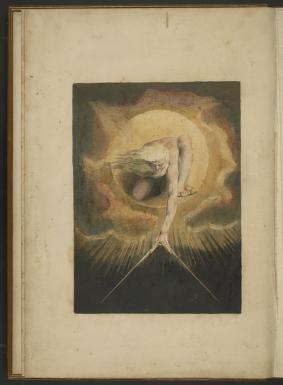 Europe, a prophecyThe English poet, illustrator, and engraver William Blake (1757-1827) first published Europe, A Prophecy in 1794, one year after the appearance of his America, A Prophecy. In both books, Blake attempted to discern the pattern behind human history, and in particular in the momentous events occurring on both sides of Atlantic between the end of the American Revolution in 1783 and the outbreak of war between France and Great Britain in 1793. At first an enthusiast for the French Revolution, Blake saw a world of deprivation and misery emerging in Europe, as depicted in \"Famine\" (plate 9) and \"Plague\" (plate 10). The frontispiece (plate 1) includes one of Blake's best-known works of art, \"The Ancient of Days,\" which depicts God the Father as a powerful figure, striking the Earth with a pair of compasses. Most of Blake's books were not published in the traditional sense but were printed for special commissions by private collectors or London booksellers. As a consequence, they are extremely rare. This copy, from the Lessing J. Rosenwald Collection at the Library of Congress, is one of only nine surviving copies of the work. World Digital Library.
 -
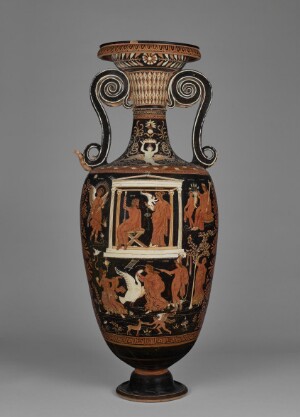 Apulian Red-Figure LoutrophorosFrom upper left: AΣTΡAΠΗ (Astrape), ZEUΣ (Zeus), AΦΡODITΗ (Aphrohdite), ENIAΥTOΣ (Eniautos), ELEUΣIΣ (Eleusis), ΛΗΔΑ (Leda), HYΠNOΣ (Hypnos). On the interior mouth of the vase is a three letter dipinto (red), PXE.
 -
Railroad Car in New Paltza test image for the railroad resource template
-
-
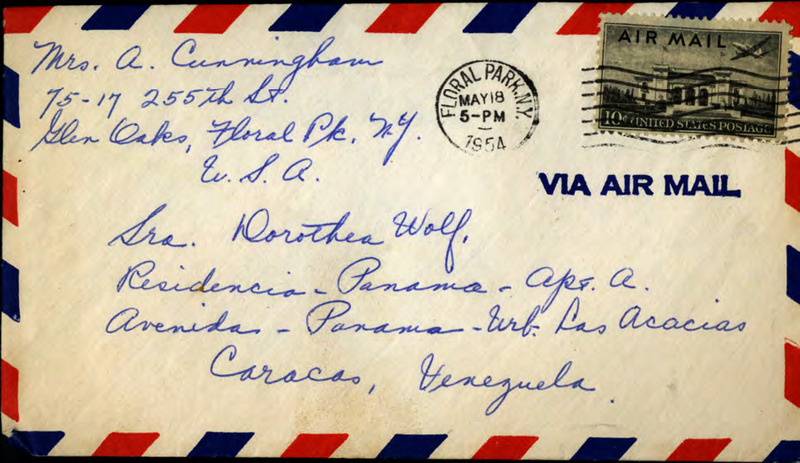
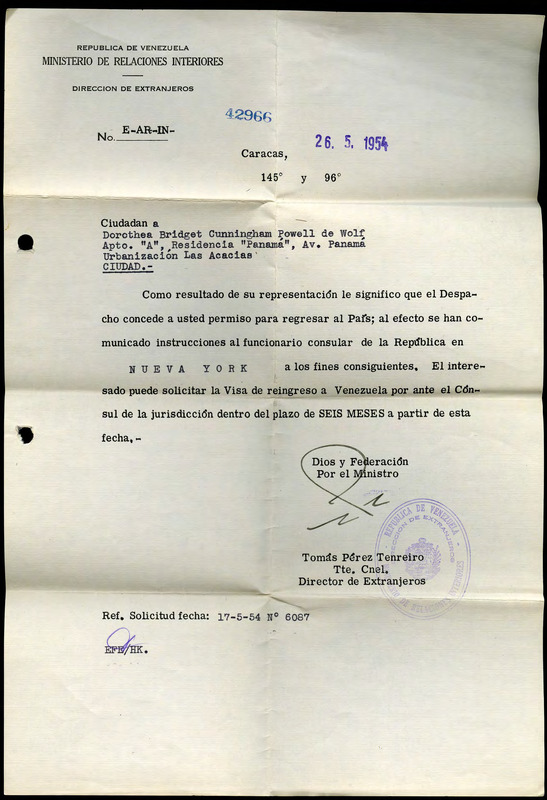
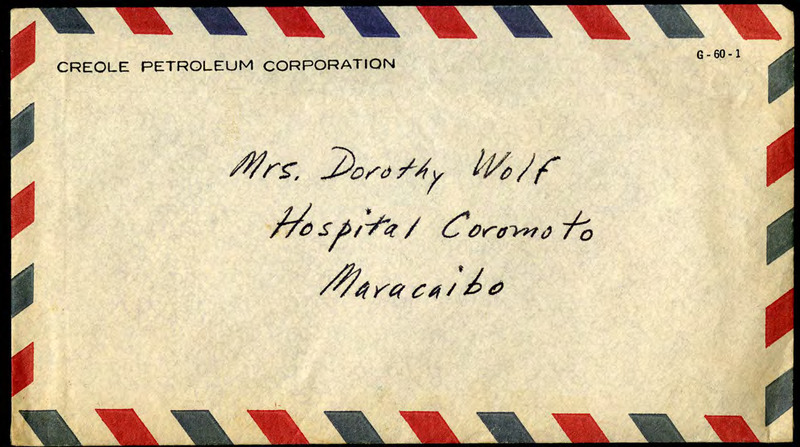 Letter to Dorothea WolfDorothea Wolf had her gall bladder removed, major abdominal surgery in those times, while in Venezuela. Her friend, Maggie, wrote to her while she was in the hosptial.
 -
This is the "Italic Title" block style.
This is the "Subtitle" block style.
This is the "Special Container" block style.
This is the "Marker" inline style.
This is the "Big" inline style. This is normal text.
This text is inside a "small" inline style. This is normal text.
This is the "Computer Code" inline style.
لكن لا بد أن أوضح لك أن كل هذه الأفكار المغلوطة حول استنكار النشوة وتمجيد الألم يعرض هذا النص من اليمين إلى اليسار.
Welcome to your new site. This is an example page.
- This is a bullet list.
- Second entry.
Back to normal again.
- This is an ordered list.
- Second entry.
Back to normal again.
This is a blockquote.
Back to normal again.
This text is bold, in a <strong> tag.
This text is italicized, in an <em> tag.
This text is underlined, in a <u> tag.
This text has a strikethrough, in a <s> tag.
This text is subscript and superscript using <sub> and <sup>, which can be used for adding notes and citations.